


Plain-English summaries
Read retrieved official summaries and completed assessments, with original sources linked.
VoteImpact is a free bill tracker for Congress and all 50 states. See what lawmakers are deciding right now, in plain English, with the official record behind every claim.
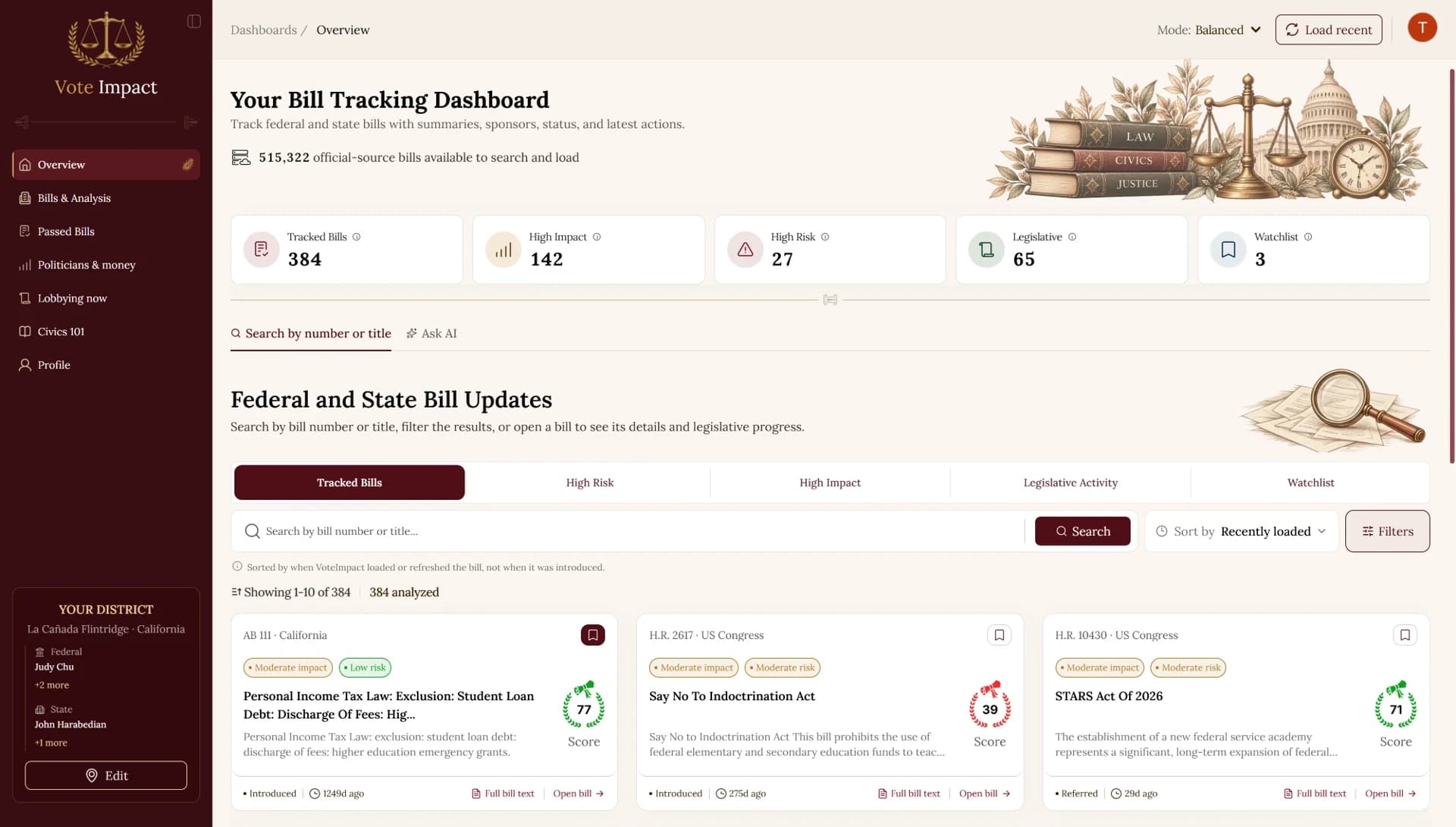
Explore bills by the issues that matter to you.
Three steps: find the bills that reach you, check where they come from, then read what they do in plain English.

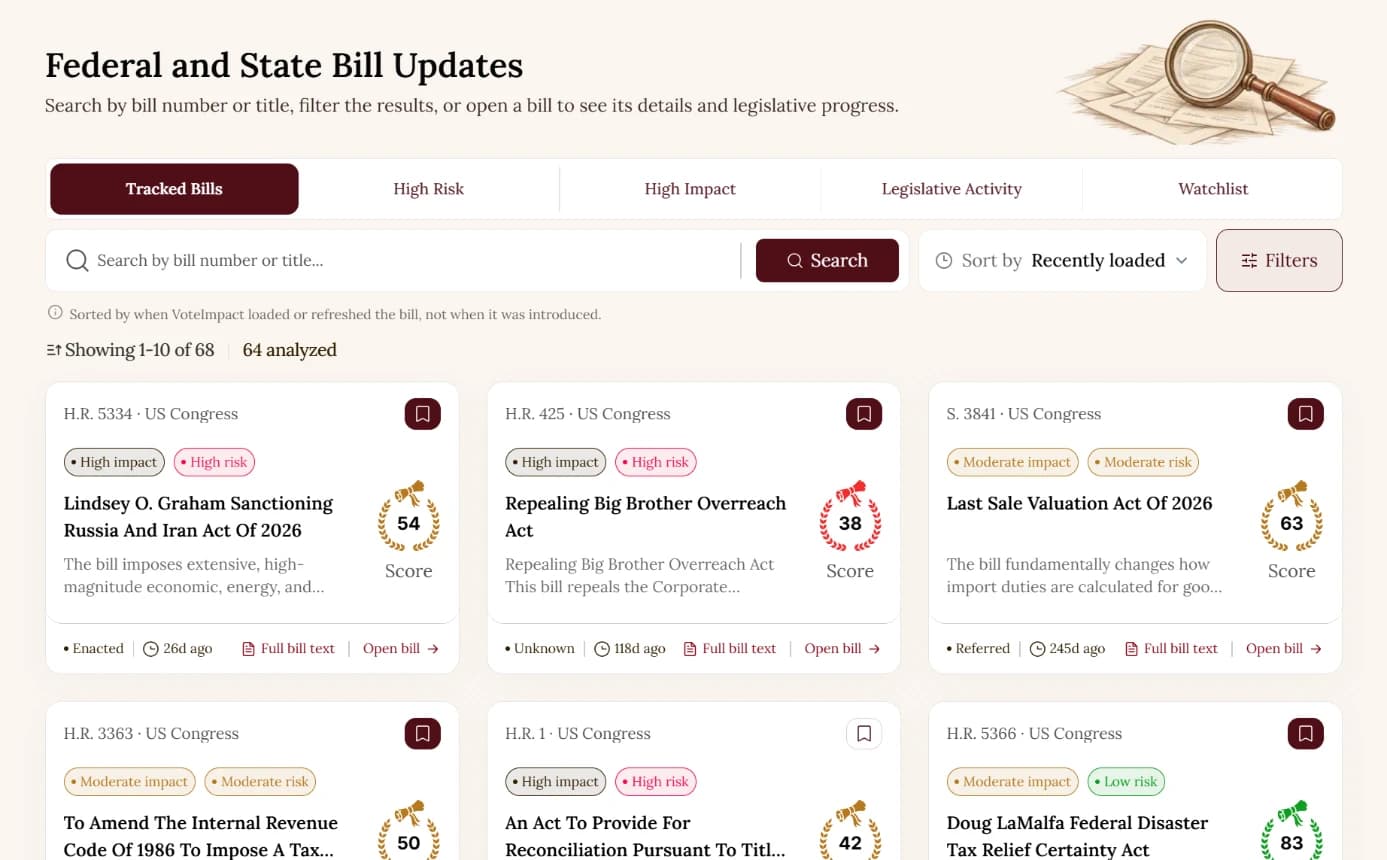
Search by bill number or title, or switch between tracked, high-risk and high-impact bills. Bills still being decided come first.
Six things, stated once each — what a bill says, who it reaches, where it stands, and where every word of it came from.
Read retrieved official summaries and completed assessments, with original sources linked.
Risk, impact and civic-fit scores derived from the bill’s text — never from party labels.
See how scores are calculatedSet your location to filter by your congressional and state legislative districts, and see your own representatives.
See the latest retrieved action and separate pending proposals from enacted laws and historical records. Verify time-sensitive decisions on the official source.
Ask questions about any bill and get short, clear answers grounded in the bill text — every answer cites where it came from.
New to how legislatures work? Built-in guides explain committees, readings, vetoes and every step in between.
Every state legislature plus the U.S. Congress — pick yours to see what's moving right now.
53 jurisdictions
Voter Assistant
AI · Online
Does California's AB 3150 change anything for my house?
Yes — brush-clearing rules now apply to homeowners, and hazard maps are refreshed every 5 years.
Is my street on one of those maps?
You're in a moderate hazard zone. AB 3150 is on your watchlist now.
See what your representatives are actually voting on, before election day.
Everything you need to know about how VoteImpact tracks, analyzes, and delivers legislative updates for your district.
Yes. Tracking bills, reading summaries, and browsing every state and federal dashboard is completely free, and you don't need an account. Creating a free account only adds extras like watchlists and saved locations.
Search imported records by number or topic, open the bill and bookmark its permanent public page. Existing workspace bill pages may also offer Watch Bill when you sign in.
The import targets the U.S. Congress and all 50 state legislatures. The catalog shows current import and assessment counts separately. Every bill page links its source; state discovery records still require official verification.
Federal records come from Congress.gov and GovInfo. State discovery uses OpenStates and links the legislature’s source records. Source imports and completed analysis are labeled separately.
Imports and source refreshes run automatically and may pause for provider limits. Check the record’s retrieval date and official source for time-sensitive status, hearings or votes.
General policy-impact scores and structural corruption-risk assessments are different. Catalog corruption scores require a reviewed text version, citations, counterevidence and a disclosed rubric. Unassessed records have no score. Read the methodology and each assessment’s limitations.
Set your location and VoteImpact shows your congressional district, your state legislative districts, and the officials who represent you — plus how to contact them about any bill.
Free bill tracking for Congress and all 50 states. No account, no paywall, no spin.
New to this? Start with Civics 101
Bills with the latest official action in Congress.
The bill improves the retention and recruitment of the Indian Health Service (IHS) workforce by providing flexible service options for scholarship and loan repayment recipients.
The bill expands federal tax credit eligibility to millions of young adult workers, creating a notable shift in national tax policy and budgetary outlays.
The bill mandates nationwide labeling requirements for all clothing retailers, imposing significant new regulatory compliance costs across the entire apparel industry.
This bill restores the authority for businesses and organizations that provide care or care placement services for children, the elderly, or individuals with disabilities (care-providing businesses and organizations) to request national criminal history background checks for contractors and for individuals they certify or license. Federal law authorizes care-providing businesses and organizations to request national criminal history background checks for certain covered individuals. From 1994 to 2018, covered individuals included three categories of individuals: (1) current or prospective employees or volunteers; (2) current or prospective owners or operators; and (3) anyone who had, may have had, or sought to have access to children, the elderly, or individuals with disabilities (e.g., contractors and licensees). In 2018, the Child Protection Improvements Act removed the third category, narrowing the scope of covered individuals to just two categories: (1) current or prospective employees or volunteers, and (2) current or prospective owners or operators. Under the law, an individual in one of the categories who has, may have, or seeks to have access to children, the elderly, or individuals with disabilities is a covered individual. This bill expands covered individuals to include additional categories: (1) current or prospective contractors, (2) current or prospective employees or volunteers for a contracted entity, and (3) individuals licensed or certified by a business or organization. Like the 2018 law, an individual in one of the categories who has, may have, or seeks to have access to children, the elderly, or individuals with disabilities is a covered individual.
The bill mandates a federal research and pilot program to address microplastic contamination in water and soil, which will materially shift environmental research priorities and infrastructure evaluation standards.
The bill establishes a mechanism for federal agencies to stabilize their technical workforce by converting temporary contractors or time-limited employees into career civil servants.
